This past weekend, I worked exclusively with expired black-and-white film. Agfa Isopan ISS dated to 1974, Ilford Delta 3200 expired in 2004, Kodak Plus-X Pan, and a mystery roll that turned out to be Fomapan 400. Some came with an expiration date. Others offered almost nothing about their age or how they had been stored. Each roll asked the same question: how much could I still trust it? With familiar, fresh film, I have a starting point. I know roughly what to expect from an exposure and how my development will translate it into a negative. This weekend, that confidence was harder to come by. The speed printed on the packaging was a reference, but I had to decide what exposure to actually give the film. I exposed the Isopan at EI 25, the Delta 3200 at EI 400, and the Plus-X at EI 32. For the Fomapan, I used a meter setting of 64 with a yellow 15 filter. These were choices for the rolls in front of me, rather than recipes I could confidently apply to another batch. An expiration date only tells part of the story. For the rolls without one, I couldn’t even estimate how long they had been waiting to be used. Their storage history was another missing piece. I was making decisions with incomplete information, and the results would have to tell me whether those decisions were sound.
That uncertainty followed me into every photograph.
I still wanted a photograph worth making. I paid attention to where the light fell, what detail I wanted in the shadows, and whether the composition justified releasing the shutter. There was no way to check whether the film had recorded what I intended. A meter reading gave me a measurement of the light; it couldn’t tell me what remained of the film’s sensitivity. Meanwhile, the scene kept changing. Clouds moved, people crossed the sidewalk, and light slipped across buildings. The opportunity for a good exposure could be brief, and I was trying to meet it with material whose response I didn’t fully know. That made intent and focus feel especially important. I couldn’t remove the uncertainty, but I could give each frame my attention. Development brought a second set of decisions. I wanted to see how these aged emulsions would respond to the chemistry I use today. A familiar developer didn’t give me a familiar baseline for film with an unfamiliar history.
For this experiment, I used Rodinal at 1:100 for one hour, with agitation at the thirty-minute mark—a semi-stand approach. Rodinal itself has a long history, so this wasn’t simply a meeting of old film and a new invention. The question was how these particular rolls, after years or decades of aging, would respond to that process. Until I opened the tank, exposure and development were still assumptions.
Pulling out negatives with usable images was a relief. Finding exposures I was happy with was better still. Across the photographs, the differences are visible: heavy grain in the night scenes, softer tones in some street photographs, and strong contrast in the skies. Seeing those results together made the experiment feel much more tangible than any prediction I could have made beforehand. I’m now four for four with my recent expired-film experiments, which is probably enough success to make me a little too confident about the next roll. But what I want to carry forward is the attention this weekend required. Every exposure was an unknown. Each one was also a deliberate attempt to make something worth keeping.
View the gallery of all the photographs from the experiment.
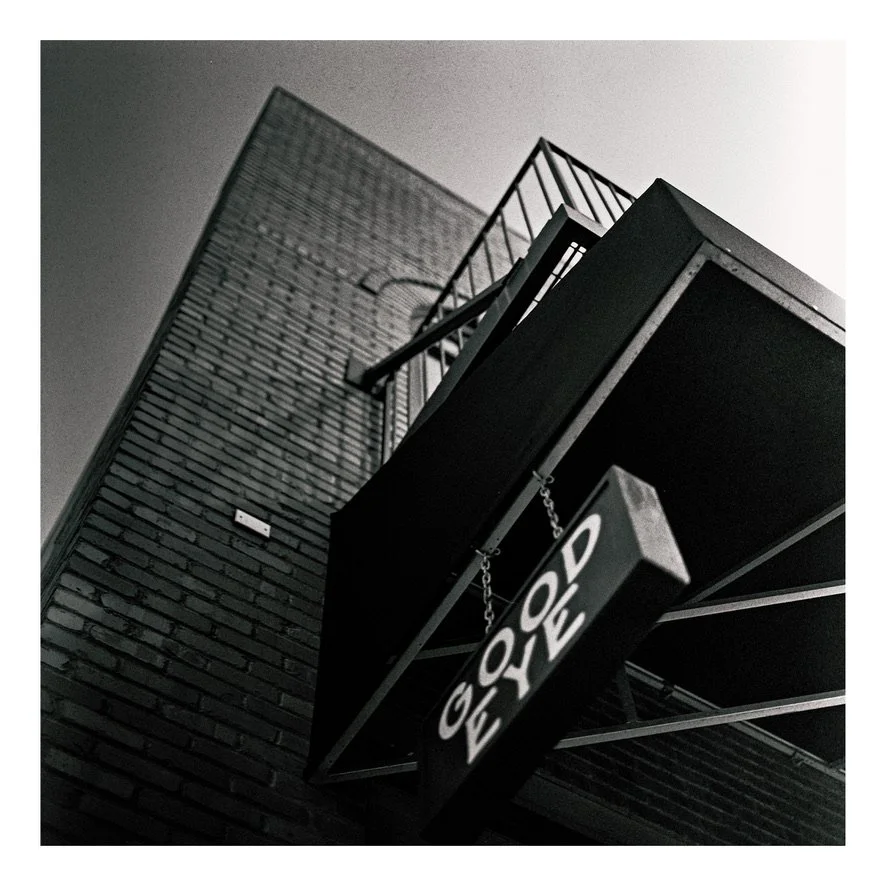
Unknown expiration date Foma 400 shot 64 ISO
